This is a blog featuring my personal stories of food, gardening, yachting, photography, travel and life.

Tuesday, June 12, 2012

The Windmills of La Mancha and Alcala de Hanares

La Mancha! Don Quixote, Miguel Cervantes, Dulcinea, Sancho Panza. All names that made the region south of Toledo famous.

Today we decided to make a quick drive through this region before heading back north to the Madrid airport and a flight out to Toronto tomorrow morning.

From Toledo there are several drives that take you on journeys through the countryside. We selected the tour through La Mancha that ended in the village of Consuegra, famous for its castle on the hill above the town surrounded by a half dozen white washed windmills of Don Quixote fame. There was quite a drive up the hill to get to the castle and windmills that also offered amazing 360 degree vistas.  At the top the wind howled explaining exactly why these windmills were put here and why the adjacent distant hills sport giant modern windmills providing electric energy for the region.

We took lots of photos and walked all the way to the top most windmill before hopping in the car and driving into town. It was a pleasant little town with nothing going on and most everything closed. The church was closed. Nothing to see there. There was a river that flowed through town but it was dry. So we headed out to the edge of town to catch the freeway back in the direction of Madrid. We found a gas station so we filled the tank with only 20 worth as we had prepaid for our fuel at the end of the trip.  So we didn't want to leave too much left in the tank when we turned it in.

One of my favorite shots at the church in Orgaz
On our drive back to Madrid we made the decision to head east of Madrid for another quick stop. This time to another World Heritage site.  Alcala de Henares.
 +++++++++++++++++++++++++++++++++++

Mora, was our first stop in La Mancha. It turned out to be kind of a dud, so we drove a bit further to the next stop on the tour. The town of Orgaz, yes that was its name, is famous because El Cid was the first mayor. It had a simple but lovely church, a simple square with a restaurant or two and a few shops, all of which seemed closed. Orgaz also sported a rather old bridge that crossed a dried up river. We drove around a bit and then exited the town heading for Consuegra.

The storks nesting in Alcala
By this time we were getting the idea that these little stops in the road were really just a ploy to get people to stay a little longer in the Toledo area and add a bit more to the local economy.

Our stop in Alcala de Hanares was an afterthought. It wasn't a part of the tour but a quick side trip after getting back to Madrid. We still had a few hours to spend before we really needed to get to the airport to return the rental car so we drove on by the airport turn off and about 20 minutes east to this beautiful city.

Alcala contains a major university, The University of Alcala, many historic buildings from the Renaissance era and it is also home to the Roman city of Complutum complete
 with it's forum, baths, market and basilica.

The Archbishop's Palace is where Christopher Columbus had his first meeting with Elizabeth the Catholic and it is where Catherine of Aragon, one of Henry the Eight's wives, was born.

This city is also the birthplace of Miguel Cervantes and where he was baptized. His birthplace is a museum today.

The sad part was when the TI informed us that it was Monday and that the entire town's historic monuments were closed.

We were able to walk around a bit and take in the commercial street and Plaza de Cervantes dressed up in its springtime splendor.

Leslie settling an argument between Don Quixote and Sancho Panza
We also had nice views of the mascot critter of Alcala, storks, who built their enormous nests in the treetops and the bell towers all over town. Their curious bill-snapping sound can be heard all over.

The drive back to the airport was a bit stressful but the signage for getting there and returning the car were easy to follow. We had the car turned in in no time and were on a shuttle to the Airport Ibis Hotel within a half hour. Tomorrow we head back to the airport for our flight to Paris and then on to Toronto.

After a restless night at the Ibis Hotel near the Madrid Barajas Aeropuerto, we got a wake up call at 6:30 am. A quick shower, packing the few belongings we needed for the night and we were out the door and to the airport by 7:30. Check in had to be done using electronic ticket machines. Only the business class got to speak to a real person. As we approached the maze of poles and straps that eventually lead to the machines, an Air France employee intercepted us asking if we had carry ons. We indicated that we were carrying on everything. He passed us through to the ticket machines after tagging our back packs.

When we finished with the machines we headed back out but the same guy intercepted us again and told us we had to check our bags. I told him we had made the same flight coming to Madrid and were able to carry on all our luggage. He insisted some airlines have different policies. I countered with, we came on this airline. He didn't want to discuss it anymore so he rudely grabbed my luggage and started rolling it toward a counter where they would check our luggage. The same counter he said earlier we could not go to to check in with a real person.

So, despite the fact that we purposely purchased smaller luggage so as not to have to check our baggage, our luggage is in the hold of the plane and checked through to Toronto. The good news is we didn't have to pay extra for this privilege. More good news. We were seated in emergency rows so we have lots of leg room. Even better is the fact that it is a short flight to Paris where we have to change planes for the flight to Toronto.  We are supposed to be in the two middle seats in a row of four on that flight. That's the bad news.

I was really cranky this morning after not sleeping well, again. When we got to the airport I needed water, coffee and something in my tummy. With that accomplished and an hour of relative peace and quiet sitting, watching out the window as planes landed (doing that gives me endless hours of fascination), I began to calm down. Have I told you how much I hate flying? Next time we take a cruise! Or a much shorter flight.
One last sigh remembering Sagres, Portugal, my favorite stop on the trip.
See you in Canada!

Flight AF1001 from Madrid to Paris took off and landed on time. We tried to hustle over to gate F54 from F 2, but it turned out to be a long walk interrupted first by a passport check, then another security station where we had to unpack our carry on and go through the now familiar, since 9/11, routine of removing your belt, all the items in your pockets, taking out your camera, lenses, computer and any other electronic gadgets you might be toting. Then, reverse the process and you're on your way. It turns out somehow that Gate F2 is nowhere near F54. The walk between the two was so far you'd have thought you'd walked to an altogether different terminal.

The flight took forever to load due mostly to the disorganized fashion AirFrance did the job.  Then, the pilot came on the intercom to let us know the emergency lighting system was not working so workers came onboard to fix it. We waited for over an hour at the gate before we were cleared for take-off.

Well, that's it. We made it. Lived to tell the story as they say. Thanks for joining me on our adventure. I hope it has been even a bit helpful toward your planning a trip to the Iberian Peninsula. Spain and Portugal are two amazing, not-to-be missed countries. Every region offered special historic delights to see and equally delightful culinary delights. I also hope I have given a few insights that will help you avoid certain pitfalls of traveling. I hope to hear from you with comments about your own experiences or to offer suggestions.

Please join me over the next few weeks as we explore some of the  cities of eastern Canada, parts of Vermont and upstate New York.


Bon Voyage!

Thursday, June 7, 2012

Holy Toledo!


Holy Toledo! Okay, I won't say that again. But this is an amazing city. After breakfast in our hotel, we headed first for the Catedral de Toledo only a block away. No photos! Oh yeah, well how come everyone is taking them? So I did too. No flash, just crank up the film speed and hold on tight to a pillar or pew. I got some great shots. This has to be one of the top cathedrals in all of Europe. I know it is high on my list. Everywhere you look are works of art, statuary, paintings, metal and cloth artifacts, masterpieces all. Point the camera and shoot. You'll probably get a great picture. It's that amazing.


From the carved choir seats, the stained glass, the stunning opening to the sunlight cut through the ceiling to shine down on the people below, past sculptured figures of angels and saints high up in sculpted clouds, it is just overwhelming. The Catholics of that time certainly never heard the words: conspicuous and wealth.

Next we walked over to a museum that seemed to be basically the museum of Toledo. It housed artifacts from the earliest times through to the end of the 19th century. Very nice Roman artifacts, tiles, sculpture, painted planks of wood, sepulchers, plus a large collection of paintings including a number by El Greco, who found fame and fortune here in Toledo.

Lunch was at Restaurante Palacios where we shared a soup called Judias con Perdiz or bean soup with partridge. It basically tasted like our American navy bean soup but had chunks of partridge, a local specialty here. Mostly you picked bones out of your mouth due to the fact that there are more of those than meat on a partridge. Then I ordered my second Cochinillo asado (had it in Segovia if you remember), roasted suckling pig. Leslie ordered Pollo asado. Both were delicious and came with a side of sliced potato in a rich brown sauce. A bottle of so so wine and a bottle of agua con gaz and we were set. Out the door for only 39. Holy Toledo! For lunch? Oops! Said it again!
Funny street sign in Toledo...Spain!

We wandered a bit more around a couple of other squares before I had Leslie drop me off at the hotel. I need to catch up on laundry before we leave Spain and head for Canada and I have 3 days for it to dry here. We'll go out exploring some more tonight.

Well, my tummy had other plans than to do more exploring this evening so we stayed in and made our plan for the last day in Toledo.

Our final day, we grabbed our city maps and headed off towards the north end of Toledo looking for a couple of mosques. We found the first one which turned out to be an art store selling glass plates and jewelry and playing rock music. The store just happened to be a mosque at one time. Little existed that would lead you to believe it was ever such a thing. Disappointing.

We walked up and down several streets trying to find the other mosque shown on the map but couldn't find it or perhaps we weren't looking in the right street. The city maps are not always very helpful.

Next, we headed off in the direction of the old Jewish quarter. Again, very little exists of that once rather large section of the city. Beginning in the late 1400's the Sephardic Jews were basically given a choice which was to convert to Catholicism or get out of town. Some converted, others left heading to other regions of North Africa, the Middle East and northern Europe.

The Sephardic Museum is housed in a former synagogue and parts of the ornate walls and the beautifully decorated ceiling are still in tact. There is also a nice little exhibit of the traditional clothing, jewelry and holy artifacts. I enjoyed the little museum but when all was said and done, I couldn't get over the fact that the Jews and Muslims were treated so poorly by the racist views of the Church that persisted well into the 20th century. After all, the Catholics were killing Jews in the 15th century and the Nazis took over in the 20th.

We bought a lovely picnic lunch and took it back to our hotel and ate out on the balcony off the breakfast room with a great view across the rooftops of the city. The sun was bright and warm. We leave Spain with the trees beginning to leaf out, spring flowers are blooming and the temperature, though still a bit chilly at night, is warming up nicely during the day. And we can't help noticing that the crowds of tourists seem to be growing significantly. When we arrived 3 weeks ago, we often found ourselves the lone Americans in a town or village and few others save locals or Spanish and Portuguese on holiday. Even the Brits who so commonly inhabit the the Costa del Sol and the Algarve, were few in number. We really felt like the place was ours. But since arriving in Toledo, the crowds have definitely grown.

My biggest surprise is the growing number of Chinese tourists. Where for decades of European travel it has always been bus loads of Japanese tourists, now the newly affluent Chinese are beginning to discover travel. It is wonderful to see though I recently read that due to the influx of Chinese travelers the prices in hotels has risen as space availability has shrunk due to demand. Still, the more people travel, the smaller the world gets. You can't travel and not begin to better understand other cultures. Sitting in a plaza in Toledo watching a young family playing, a group of old men having a laugh as they argue over a game of bocce ball or groups of young people from different cultures laugh and sing together, you can't help but grow more understanding, tolerant and to realize we are all much more alike than different.
 
Tonight we went out to rambla through streets of Toledo one last time. Stopped to have dinner in a small square. Restaurante Alcazar turned out to be a good location and good service but the food was awful. Grabbed a fresh hot baguette and a couple of waters in a store on the square and rambla'ed back to the hotel. We are both packed except for the last personal items to go in the bags in the morning. Then we rambla uphill back to the car park and head for Consuegra, heart of La Mancha before going to our airport hotel in Madrid.

Wednesday, June 6, 2012

Segovia and The Valley of the Fallen

On our way to Segovia today. A quick stop to walk a bit through Avila, a walled town with what must be one of the best restored city walls anywhere in Europe. It looks brand new but has been standing since the 12th century. It is also the location of the convent of Saint Teresa. Not much else to report on there but it is a lovely city.

The convent of Saint Teresa
Moved on to Segovia. Had our usual issues with finding our way into the old city. So many one way streets and traffic signs directing you not to enter here or turn there. We finally found our way with the help of a couple of folks. Our hotel, Hotel Infanta Isabel, room 308, sits right on the Plaza Mayor at the highest point of the city. The cathedral is right out our window as is a lively bustling plaza filled with folks out strolling or shopping.

We ate at Meson Don Jimeno Restaurante down a little side street on the way down to the Alcazar. We were the only ones in the place which was a bit scary since we had no advice as to whether it was good or bad. But they unlike most other restaurants at that hour, we're open and they were serving the two dishes we were hoping to try while here in Segovia--Cochinillo asado, roasted suckling of pig, and Judiones de la Granja, a bean and bacon stew. We also tried their pig pate and a wonderful bottle of 2009 Tempernillo vinted by Zarraguilla cellars near Segovia.

View from our room in Segovia
The meal was wonderful. Whether the dishes were prepared correctly or not, since we have no frame of reference, they were just delicious. The pork was so rich, the skin crunchy and golden brown. The Graja was deeply satisfying with white beans the shape of large limas and thick slices of bacon that had to have been simmering all day with those beans. Wow!

Tomorrow we head for our last city in Spain--Toledo. On the way we will tour the Valley of the Fallen and drive around Madrid on the way south. Three days in Toledo and we head back to the Madrid airport to turn in our rental car and spend one last night near the airport before our flight to Toronto.

Our three weeks has gone by so quickly here, but we are looking forward to our two weeks in the Canadian eastern cities, Vermont and New York. Lots more travel yet to come.

As I said, our short stay in Segovia was followed by a big day heading to Toledo.

Had a breakfast of coffee con leche and a croissant at the cafe right next door to our hotel. Then packed up and headed out of Segovia. It is a lovely, compact town with lots going on. Love to return someday.

El Escorial
Our next stop was El Escorial, city infamous for the Monasterio de San Lorenzo de El Escorial. Built by King Phillip II as a palace, he also directed the Inquisition from here. It is a giant, depressing building built at the cost of a generation of Spain's wealth. It is a museum now. The areas open to the public are filled with art from that period. Other displays focus on the construction of the building and in still others you descend into the crypts of former royalty and their offspring. Even the basilica's decor reflects the sparse and dreary nature of the times, most parts looking like they were built of cinder block and the grey walls are most of what greets you. The alter is the main focus and though lovely it is still nothing really spectacular. I most enjoyed the library near the end of the tour.  Thousands of books line the walls and down the middle are globes and other artifacts of interest. My favorite being the armillary sphere which reflected the thinking at the time of the earth being at the center of the known universe and the known planets circle around it. It is a beautiful, but obviously flawed instrument.
Plaza outside El Escorial

After a quick lunch in town, we headed for the Valle de Los Caidos, the Valley of the Fallen only a few km down the road from El Escorial.

The turn off to the monument in the Valley of  the Fallen is right along the road to El Escorial. A large granite gate marks the spot and a two lane road leads a few km up into the pine forested Guadarrama Mountains. As you cross a bridge, off to the right on a hilltop is the 500 foot cross built from the granite carved out of the hill to create the basilica and monument below.

Plaza and entrance to the Basillica of the fallen
The cross above the Valley of the Fallen Monument
It is a disturbing place to visit due to the fact that it is not only the tomb for some 50,000 of the dead from the Spanish civil war from 1936 to 1939, but also because at the high alter are buried both The founder of Spanish fascism and General Franco, the man who is responsible for starting the civil war and even accepting the help of Nazi Germany to kill thousands of civilians. Behind the alter and in two side chapels, locked behind closed doors are the 50,000 who died for god and country from both sides. Franco is the focus in this basilica however and that is what most disturbs me. It would seem to me somewhat like going to visit Hitler's grave were there one to visit. Who, other than neo-nazis would visit such a place? We both left disturbed and scratching our heads over this monument to fascism. I'd love to talk with a Spaniard who could explain this place.

The sad thing today was that none of the places we stopped to see would allow photography inside the buildings so I have little to show for El Escorial and the Valley of the Fallen. I snuck a couple of photos inside El Escorial. I don't know what the harm is in taking non-flash photography. It hurts nothing and any copyrighted material became public domain long ago.

Leslie in front of our hotel in Toledo
Our final stop in Spain was Toledo, a city named a national monument and a UN World Heritage site. It sits on a hilltop south of Madrid so we had to travel a bit over ground we had already taken a train through near the beginning of our trip. But we didn't want to miss this city so we drove the hour or so out of our way to make sure we saw it.

We found our hotel very quickly after parking the car in a public lot. La Posada de Manolo sits on quiet, winding Calle Sixto Ramon Perro. We got a room with a small balcony. No view but there is a lovely courtyard view out another window. It is a lovely room and it will be our home for the next 3 days.

Thursday, May 31, 2012

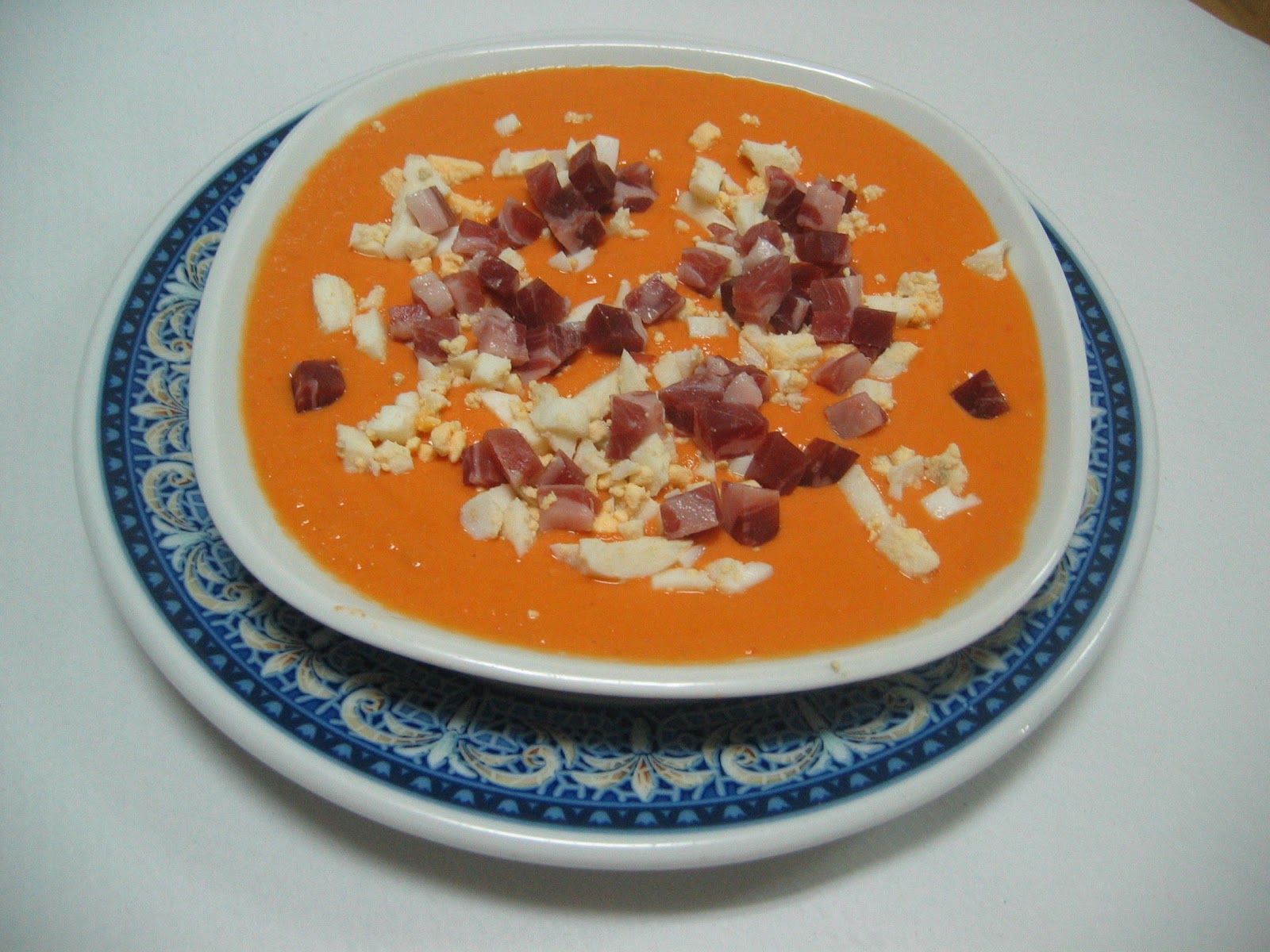
Salmorejo Recipe


Salmorejo

I promised I would post this recipe at some point in my blog after talking about how great it was when we had it while visiting Spain. So, here it is.

This style of cold soup originated in the city of Córdoba in the south of Spain. When preparing this dish, you'll want to use two kinds of olive oil: A lightly flavored oil is pureed into the soup, but a stronger, fruitier Spanish oil gets drizzled over just before serving, for a flavorful accent.


Ingredients
·         2 cups room-temperature water
·         1 tablespoon coarse kosher salt
·         2 cups (packed) coarsely torn day-old baguette with crust (about 4 ounces)
·         10 plum tomatoes, halved, seeded, coarsely chopped (about 6 cups)
·         1/3 cup coarsely chopped onion
·         1/4 cup Sherry wine vinegar
·         1 1/2 tablespoons fresh lemon juice
·         1 garlic clove, peeled
·         1 1/2 cups lightly flavored extra-virgin olive oil
·         3 hard-boiled eggs, coarsely chopped
·         1/3 cup chopped Serrano ham* (about 1 1/2 ounces)
·         Fruity Spanish olive oil (for drizzling)

Preparation
·         Stir 2 cups water and 1 tablespoon coarse salt in medium bowl to dissolve. Add bread; soak 30 minutes. Squeeze excess liquid from bread; reserve soaking liquid.
·         Puree half each of chopped tomatoes, chopped onion, Sherry wine vinegar, fresh lemon juice, and garlic in blender until very smooth. With machine running, gradually add half of bread, adding reserved soaking liquid by tablespoonfuls if mixture is too thick to blend. Puree until very smooth. With machine running, gradually add half of light extra-virgin olive oil (mixture will turn slightly orange). Transfer to large bowl. Repeat with remaining chopped tomatoes, chopped onion, Sherry wine vinegar, fresh lemon juice, garlic, bread, and oil. Cover and chill at least 2 hours and up to 1 day. Season to taste with salt.
·         Divide soup among small bowls. Sprinkle chopped egg and ham over. Drizzle with Spanish olive oil and serve.
·         *An uncooked, cured Spanish ham (also called jamón Serrano); sold at specialty foods stores and Spanish and Latin markets. If unavailable, prosciutto can be substituted.

        Makes 8 servings

Coimbra and Salamanca


Arrived in our last stop in Portugal, the university city of Coimbra. Since the year 1290, Coimbra has been home to It's university. We. We're just here for the day and as it turned out, not even that long.

We headed toward Coimbra taking some toll roads. Nothing we hadn't been doing all along, but in places in Portugal they have an automated system that reads your license plate and compares it to a computerized list of those who have pre-purchased their tolls on these roads. In the south we figured out how to use it and things worked fine. Suddenly, here in the north, we came upon the system again but could find no one who could help us pay for our tolls. No one even knew much about this new system.  No one could take our .50 (note that's .50) in tolls and we couldn't prepay for the short amount of time we'd be on the toll road before leaving Portugal without our paying 50 (that's 50) that was non-refundable. So it remains to be seen what or how this will come back to haunt us in the future. But rest assured it will.

In the meantime, we got checked into our Pousada outside Coimbra. Lovely hotel but not nearly the stunning setting as Sagres down south. Oh well, we'll muddle through.

Getting lost in Coimbra was easy. Getting unlost became a bit of a point of contention or us but we finally found the old city and a parking place. It was late enough that our choices for lunch had luckily diminished. We intended to try one of two places on our map but couldn't find them. It was almost closing time for those two cafes, so rather than continue trying to find them we decided on a third choice which was, by now, closer and had no closing time. Lucky us!

Goat stew and Pollo stew with blood in Coimbra
Adega Paco do Conde is popular with local students and families alike. You select the item, fish or meat, from the case at the front counter and they grill it for you. But we had heard that one of the local specialties here was goat stew and I was determined to try it. The owner came out and greeted us, chatting us up for 10 minutes about where we were from, life and the high cost the Euro has taken on the lives of the Portuguese. He suggested we also try the arroz con pollo with blood. Hmmmm. Okay. The two bowls arrived and the smell was heavenly. My goat stew was very salty but the accompanying plate of cooked cabbage, carrots and potatoes cut the saltiness. The meat was absolutely perfect! I'd never tasted anything with such a  richly flavored broth. It must have been simmering for hours.

As for the arroz con pollo with blood? Well, it might sound dreadful to you, but it too was just heavenly. Absolutely amazing! The local red wine and beer were great accompaniments along with the local baked bread we used to sop up the juices.

Leslie headed off to explore further into Coimbra while I remained in the quiet, sunlit Praca do Comercio, or Commercial Square, catching up on my journal and a fair bit of people watching.

After our heavy lunch we had no further plan beyond getting back to our beautiful Pousada for a final, quiet evening in Portugal.

Next day--our time in Portugal has sadly come to an end. We must head to Salamanca, Spain today and despite the fact that Coimbra never clicked with me, this wonderful, beautiful, passionate country certainly has.

We headed east toward the border on more of those electronic toll roads, stopping several times to try and pay our fees but to no avail. We are sure this will catch up to us yet, but there is little we can do. 

****A footnote to this issue. As of this posting some several weeks after our arrival back home, we have received nothing regarding our failure to pay the tolls. So we are quietly crossing our fingers and hoping the issue is settled. 

So across the border we went and after some initial difficulty finding our way around Salamanca, we eventually found our hotel nestled directly across the street from the cathedral. We even have a lovely large terrace space with a table and chairs that look out to the dome and flying buttresses of the cathedral. Fabulous view!

We headed out across the old city which is largely made up of shopping streets surrounded by university buildings. It looks a little Harry Potterish to us. Clean, largely free of the graffiti seen in most other places we've been, it is just a jewel of a city. We love it!

We walked all around the key parts looking in a few shops and for a dinner place but nothing opened for dinner until 8:30.
Our terrace in Salamanca

We found a shop that sold lovely looking pastries and meat pies and bought some for dinner. A way further along we found a place we liked where we stopped in for a glass of wine and with it we each got a free tapa.

Back to the hotel to sit out on our terrace and munch on our dinner goodies washed down with a glass of port out of a bottle we'd purchased in Portugal.

Salamanca cathedral
It had been raining pretty hard at times when we arrived but had settled down to just drop or two making a sunset dinner on the terrace possible. Still it was cold and with the sun going down it started getting even colder. Only 8 degrees Celsius when we arrived, it must have got down lower in the night.

Night view of the Salamanca Plaza Major
We slept in probably the most comfortable beds of the entire trip which was a welcome change as tomorrow is another big day of travel and sites.

Friday, May 25, 2012

Sintra, Obidos and Nazare


Adio Lisboa.  So much more to explore here and sadly not nearly enough time. The small hill town of Sintra was first on our list of places to visit today.

We instantly fell in love, as we have so many of the Portuguese cities and villages we have visited. Sintra boasts both a Moorish and a Portuguese castle each sitting on separate hilltops. Due to lack of time we visited neither, but due to it being off season we were able to stop and photograph them.

We also spent a couple of hours just wandering through the old town below the castles, meandering the narrow streets and taking photos from towering, romantic vistas of the surrounding countryside. In one of these streets we came upon a small patisserie full of locals. We ordered our now customary cafe con leche along with a few small but attractive pastries. This place looked so perfect you'd think you were in sort of Portuguese Disneyland. The warm and friendly staff served a wonderfully thick, rich cup of coffee blended with the hot, scalded milk that swirled within the cup. Can we even get coffee that tastes this good in America or is the combination of the coffee with the romantic and exotic location?
We finished our stroll through the little town and headed next to Obidos another perfect little village nestled within the ancient walls that surround it. Like so many other cities we have visited, it has suffered for thousand years from one invader after another. First the Celts in the 300's, followed by the Romans, the Visigiths and the Moors.

The wall is 45 feet tall and the steps up to it step and uneven and when you get to the top, beware. There are many places where the inside edge of the wall is a sheer unprotected drop. We managed it and we're rewarded by fabulous views from above the city inside the walls and out across the rolling hills that lie outside them.

Two main narrow streets wind through the town, the upper and lower. They both start near the main gate in the wall. Inside the gate entry way, high up on the wall is a beautiful tile mural made in the local blue colored tiles. Below it sat a lovely old woman patiently sat made her embroidered towels and other hand sewn things for the home. We meant to buy one of her dish towels, only 10, but when we left she was no longer there.

Inside Obidos is mostly shops, a few small hotels, a couple of churches (which were closed) and the castle, at least part of which is a Pousada.

A couple of hours in Obidos seemed about right and we headed back to the car for the drive to our final destination today--Nazare. On our way out of town we stopped to take a couple of photos of the Obidos aqueduct built in the 16th century.

Nazare is a beach town and crazy with sun worshipers in the summer months. But this time of year you practically have the place to yourself.  That has its old and bad sides. It is often cold and windy, especially after the sun goes down. Because the weather is so often on the chilly side tourists stay away and consequently many of the restaurants and businesses are either closed or have limited hours. Because of this problem we wound up having dinner at Mr. Pizza instead of a nicer place we had hoped to try.

Nazare is also a lower and an upper city, Sitio, connected by a funicular that rides up and down the sheer cliff giving riders stunning vistas of the lower city and the mile long beach.

We got checked into our hotel and headed out to the funicular. Our hotel choices provide one of the upsides to travel this time of year.  Prices are much lower and there is always room in the inn. We were able to stay in nicer hotels as a result of the off season prices and many of them were half empty.


At 5:30 the church bells began to peel and remained ringing for at least a half hour. The procession pulled together and began to march into the square and then into the street. Hundreds lined the streets and as the elements of the processional slowly walked by, they joined the ranks until there were well over a thousand marching through the street with purple Lenten banners, silver lanterns held high, floats held up by the faithful carrying the cross on one, a statue of Christ on another and a mysterious black draped coffin-shaped object on the third. All were decorated with flowers. VIP's walked under a canopy and bringing up the rear of the procession was a band made up of locals from 8 to 80, all dressed in band uniforms. Those lining the sidewalks fell in behind the band as they played their solemn music.
It was another of those reasons one travels. A serendipitous moment when you come upon something that feels as though it has happened for a thousand years and you momentarily become a member of a community. Amazing!


We were freezing up there in that hilltop village and as the procession marched by the lane leading up to the funicular, we split off and headed back onward the hotel. After warming up for a while we steeped across the street for that dinner at Mr. Pizza. By 9:30  we were asleep. 

Wednesday, May 23, 2012

Highlights of Lisbon


Up and out early today. We had three walking tours to take that would take us through some of the highlights of Lisbon.

There is a Metro underground station right out the front door of our hotel. We bought all day transportation passes for 5 that allowed us to use the Metro, the buses, the trolleys and the funicular that takes you up to the Barrio Alta (upper city). It is a real deal and the transportation system here is one of the best I have seen in any city in the world.

Sao Roque Church ceiling
We subwayed three stops to the funicular, a cute, very old trolley car that takes you up a short, but very steep street to the Barrio Alta. at the top we walked over to the Sao Roque church. It is a stunningly restored church with a ceiling painting as beautiful as any I have ever seen. Several of the side chapels are also must sees, especially the next to last on the left with Christ on the cross but surrounded by dozens of the cutest little cherubs you ever saw.

Down the street we came upon a little patisserie that we stopped in for a bite of breakfast. We ordered to cafe de leche and two lovely baked items. But the highlight was the people watching. This was a true neighborhood cafe and the folks lingering over their morning cappuccino and roll possessed some of the most wonderful faces you'd can imagine. I wish i could have photographed some of those sun burned and lined faces from years of sun and hard work.

Off we went until we found the trolley line we thought we wanted to take. We saw a lot of the city but suddenly the trolley came to a halt and the driver told everyone they had to get off. He left the trolley and walked towards a cemetery  across the street and disappeared leaving all the passengers wondering what happened. We all milled around getting to know each other a bit and after about 15 minutes, the driver suddenly reappeared and after we all reboarded, without a word, he continued on his route.

Eventually we figured out where we needed to be and that was in the opposite direction we had gone. So we made the decision to take another trolley and head for Belem district, about a 30 minute ride out on the edge of Lisbon.

Here we explored the beautiful Monastery of Jeronimo cloisters and church. The famous explorer, Vasco da Gama's tomb is inside this church. He is paid tribute in part of the designs in the I interior. Knots are carved into the stone pillars as well as symbols of the nautical life. Even artichokes are carved as a reminder of the effect they had on sailors suffering from vitamin C deficiency.

Down the street but also within the old Monastery it the National Maritime Museum. It houses a wonderful collection of antique nautical instruments, period uniforms, ship models and even some old boats. I was most impressed with the old navigation instruments. Other than that it was a rather disappointing collection.

Beginning to feel a bit peckish, we headed for a place we had picked out ahead of time for lunch. The Restaurante Os Jeronimo was described to us a great place for fish and we wanted to try it out. Despite being crowded we got seated within about 20 minutes and the very friendly and helpful staff helped us order just the right items. We'd read that we should allow the wait staff to make recommendations and follow them. We ordered a beer each and the waiter suggested an order of clams to start.  They were amazing! Fresh, steamed perfectly and dripping in a garlic, cilantro and butter sauce, they just melted in our mouths.
 
Our mains were great as well. I had a seafood dish which was supposed to be thickened with bread. Hard to describe but it came out with a raw egg yolk in the middle which the waiter folded into the mushy dish making it turn a bright yellow. It was like a risotto with shrimp but not.

Leslie got a fish we never did get identified but it was a whole, mild white fish that had been charbroiled and was surrounded on the plate by a small salad and boiled potatoes. It was just a lovely lunch and we topped it off with our second cafe de leche of the day.

Out the door, we caught another trolley heading back more toward the center of Lisbon and another that took us up near the top of the Alfama neighborhood. We got off and began a slow and steady climb up the hill toward the castelo, peaking down narrow side streets, into shops selling the famous Portuguese tiles and ceramic statuary and stopping to gaze out across the city below at vistas along the way. Street artists were here and there painting Lisbon scenes and selling their work.

We decided to walk back down the hill instead of taking the trolley which turned out to be serendipitous as we found even lovelier shops and eventually an artist who was selling art that we had to have.

In a small shop we spoke with a very nice proprietor who allowed us to listen to several tracks from a CD of Fado music. If we bought only one Fado CD, this is the one to get he insisted. It included several songs sung by the reputed best Fado singer of all time, Amalia Rodrigues. We have been listening to it as we drive through the countryside. Talk about mood music!

Further on down the hill we came across the artist whose art we purchased.

Finally, at the bottom of the hill we re-entered the Baixa neighborhood where we wandered through a more upscale shopping street with cafes and on to a Metro station. Three stops later we were back at our hotel. What a day!